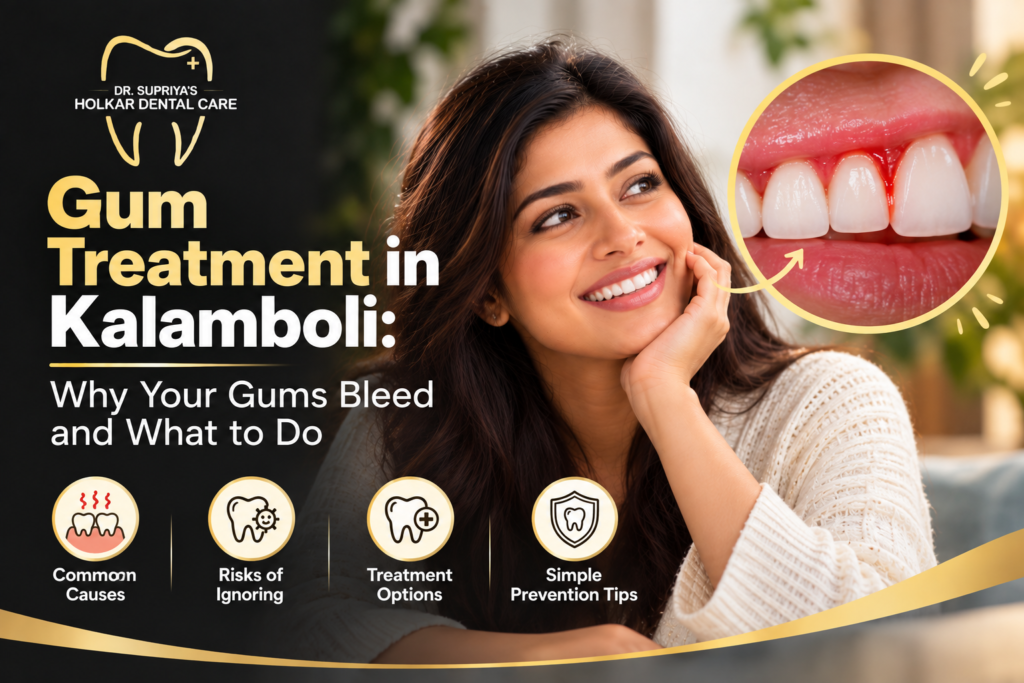
You spit after brushing and see pink in the sink. You tell yourself you brushed too hard and head out for the day.
Many people do this for months, even years. But healthy gums do not bleed. Bleeding is one of the earliest signs that something is wrong, and it is much easier to fix at the start than later.
At Dr. Supriya’s Holkar Dental Care in Kalamboli, we see gum problems in patients who thought their teeth were fine. Here is what bleeding gums mean and what to do about them.
Why do gums bleed?
In most cases, the cause is plaque. Plaque is a sticky film of bacteria that forms on your teeth every day. If it is not cleaned off properly, it irritates the gums, and they become red, swollen and bleed easily.
If plaque stays, it hardens into tartar. Tartar cannot be brushed off. Only a dentist can remove it.
Common causes of bleeding gums
- Plaque and tartar build-up. The most common reason
- Brushing too hard or with a hard brush. Can injure the gums
- Starting to floss after a long gap. Gums may bleed for a few days until they get healthier
- Gingivitis. Early gum disease, reversible with treatment
- Periodontitis. Advanced gum disease that damages the bone around teeth
- Stress, poor sleep and irregular meals. Common with busy schedules and can make gums more reactive
- Hormonal changes. During pregnancy and puberty, gums become more sensitive
- Tobacco use. Smoking and chewing tobacco harm gum health, and can hide the bleeding
- Braces, dentures or rough fillings. Can rub on the gum or trap plaque
- Some medicines and health conditions. Blood thinners, diabetes and vitamin deficiencies can play a part
Only an exam can tell which one applies to you.
Stages of gum disease
Stage 1: Gingivitis
- Red, puffy gums
- Bleeding when you brush or floss
- Bad breath
- Fully reversible with cleaning and good home care
Stage 2: Early periodontitis
- Gums start to pull away from the teeth
- Small pockets form where bacteria collect
- Some bone loss may begin
- Needs professional treatment
Stage 3: Advanced periodontitis
- Deep pockets, receding gums
- Loose or shifting teeth
- Pus, pain when chewing
- Teeth may be lost if untreated
Many people feel no pain until the later stages. That is why bleeding should never be brushed off.
Warning signs to get checked
- Gums bleed when you brush, floss or eat
- Red, swollen or tender gums
- Bad breath that does not go away
- Gums that look like they are shrinking
- Teeth that look longer than before
- Loose teeth or changes in how your teeth fit together
- Pus between the teeth and gums
- A bad taste in the mouth
- Spaces opening between teeth
If you notice even one, book a visit. If you notice several, do not wait.
When the gum problem is really a tooth problem
Sometimes a swollen, tender or bleeding area on the gum is not gum disease at all. It can come from an infected tooth.
Signs that point to the tooth:
- A pimple-like bump on the gum near one tooth
- Swelling around a single tooth
- Pain when biting on one tooth
- A tooth that is dark or has a deep cavity
- A bad taste that keeps returning
In these cases, cleaning the gums alone will not solve the problem. The infected nerve inside the tooth needs treatment, often a root canal. An exam and an X-ray tell the two apart, so you get the right treatment the first time.
Why gum health matters beyond your mouth
Gum disease is linked to other health problems, including diabetes control and heart health. The exact relationship is still studied, but the message is simple: caring for your gums is good for your whole body, not only your smile.
If you have diabetes, tell your dentist. Gum disease and blood sugar affect each other.
Gum disease is also a leading cause of tooth loss in adults, and losing teeth means more costly treatment later, such as implants or dentures. Treating gums early protects your natural teeth.
Diagnosis: what a gum check-up involves
A proper diagnosis is the most important part of gum treatment. At Holkar Dental Care, this usually includes:
1. Visual examination
Dr. Supriya looks at the colour, shape and firmness of your gums and checks for plaque and tartar.
2. Gum measurements
A small instrument measures the space between gum and tooth. Deeper spaces point to disease.
3. Dental X-rays
X-rays show bone levels and hidden problems under the gum line or around the root.
4. Medical history
We ask about your health, medicines, tobacco habits and family history, because they all affect your gums.
You then get a clear explanation of what we found, with the stage and the plan.
Gum treatment in Kalamboli: what we do at Holkar Dental Care
1. Scaling and polishing
Plaque and tartar are removed from above and just below the gum line, and the teeth are polished smooth. For gingivitis, this plus good home care is often enough.
2. Deep cleaning
For deeper pockets, we clean below the gum line and smooth the root surfaces so gums can reattach.
3. Medication, where needed
In some cases, medicines or antiseptic rinses support healing.
4. Treating other causes
Rough fillings, broken teeth or infected teeth that feed the problem are repaired or treated.
5. Home care coaching
We show you how to brush, floss and use interdental brushes in a way that suits your teeth.
6. Review visits
We check how your gums are healing and adjust the plan.
7. Referral where needed
Severe cases may need advanced gum care, and we will tell you if that applies.
If you are searching for gum treatment in Kalamboli, Navi Mumbai, or a dentist near you for bleeding gums, come in for a check-up. The earlier we start, the simpler the treatment. Honest advice, no scare tactics.
Does scaling damage teeth?
This is a common worry, so here is the straight answer.
- Scaling removes tartar. It does not remove enamel
- After a cleaning, teeth may feel sensitive or look slightly spaced out for a few days. That is because tartar that was holding things together is gone and your gums are healing
- Gaps you notice after scaling were already there under the tartar
- Not cleaning is what really harms teeth
Home care for healthy gums
- Brush twice a day with a soft brush, in small gentle circles
- Brush along the gum line, where plaque collects
- Floss or use interdental brushes once a day
- Do not stop brushing if gums bleed. Gentle, regular cleaning helps them heal
- Rinse with water after meals
- Avoid tobacco in every form
- Eat fruit, vegetables and enough vitamin C
- Drink enough water through the day
- Get a cleaning every six months, or as advised
If bleeding continues after a week or two of good cleaning, see a dentist.
Festive season and your gums
Sweets, snacks and late nights add to plaque. Many people also skip brushing when they are travelling or hosting guests. If your gums have been bleeding, a cleaning before the festive season is a good idea. It is also a good time to catch problems before they become costly.
Frequently asked questions
Is bleeding from the gums normal?
No. Healthy gums do not bleed. Occasional bleeding after you start flossing is common, but it should stop within a week or two.
Can gum disease be cured?
Gingivitis can be completely reversed. Periodontitis cannot be fully reversed, but it can be controlled with treatment and good care.
Does bleeding mean I should stop brushing?
No. Keep brushing gently. Stopping lets plaque build up and makes things worse.
How often should I get a dental cleaning?
Every six months for most people. If you have gum disease, you may need to come more often.
Is scaling painful?
Most people feel mild discomfort at most. If your gums are very tender, we can numb the area.
Can a swollen gum be caused by a tooth infection?
Yes. A bump or swelling near one tooth can come from an infected nerve. It needs an exam and an X-ray.
Is there a dentist near me in Kalamboli for gum problems?
Yes. Dr. Supriya’s Holkar Dental Care is near D-Mart, Kalamboli, Navi Mumbai.
Book your visit
Bleeding gums are an early warning. A short visit now can save your teeth later.
Call +91 97697 62957 or visit www.drsupriyaholkardentalcare.in to book gum treatment in Kalamboli, Navi Mumbai.
Clinic location: Near D-Mart, Kalamboli, Navi Mumbai